Carbon fiber looks great. Honeycomb core is in perfect shape. Everything checks out on paper. Then the whole structure peels apart anyway. What went wrong? Not the materials. The adhesive bond gave out. That thin sticky layer between parts is almost always the first thing to fail, and it rarely gets the respect it deserves until something goes sideways.
Bonds Take a Beating
Every glued joint on an aircraft gets stressed in ways most people never think about. Fuselage skins flex every single time the cabin pressurizes. Wing panels bend and twist under air loads. Control surfaces vibrate constantly during flight. Every bit of that energy passes directly through the bond line. A very thin adhesive layer, only a few thousandths of an inch thick, holds parts together even when they are pulled, peeled, or heated. Often, the parts still appear fine even when the entire structure collapses. The adhesive just hit its limit first.
Dirty Surfaces Ruin Everything
This one trips people up. Most bond failures have absolutely nothing to do with choosing the wrong adhesive. The real culprit is surface preparation. Or, more accurately, the lack of it. Metal and composite surfaces readily accumulate contamination. Fingerprint oils, residual mold release chemicals, or even a small amount of moisture on the composite’s surface can prevent the adhesive from properly bonding. The difficult aspect is that a contaminated bond may seem solid immediately after assembly. It might even pass initial pull testing. Then months later, under actual flight loads and temperature swings, edges start lifting. The adhesive never truly locked on. It was doomed from the start.
Heat and Humidity Gang Up on Bond Lines
A wing sitting on hot tarmac in Phoenix might reach over 150°F. An hour later, at cruising altitude, that same surface plunges well below zero. Back and forth, flight after flight. That constant thermal cycling stretches and squeezes the bond line relentlessly. Now add moisture. Water molecules are sneaky. They slowly migrate into bond lines over time and weaken the connection between the adhesive and the surface. Put heat and humidity together, and you get what engineers consider the single most destructive aging condition for structural adhesives. Lab results under clean, dry conditions can look fantastic. Real-world performance in a Gulf Coast summer tells a very different story.
Film Adhesives Give Engineers an Edge
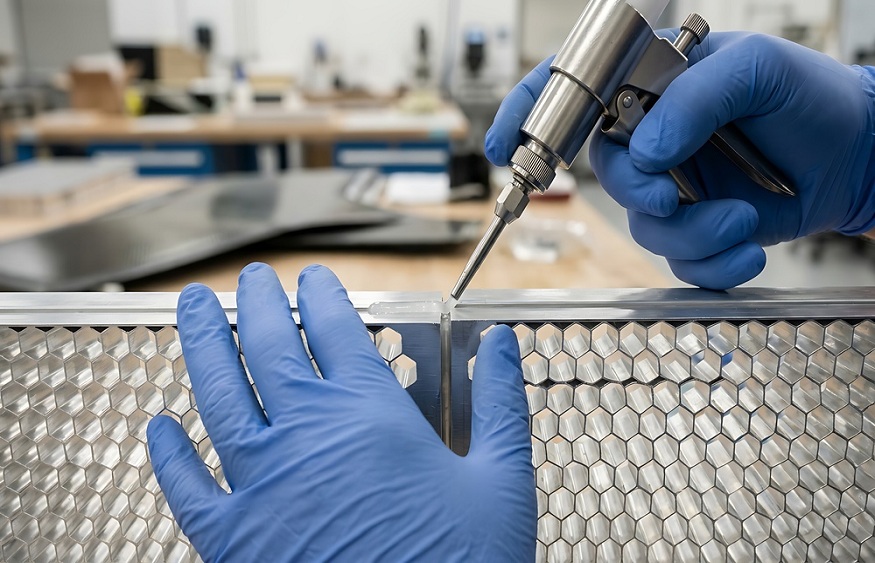
Liquid adhesives work fine for some jobs. But when consistency and control matter, film adhesives pull ahead. A film adhesive shows up as a thin, uniform sheet that an assembler lays directly into the joint before curing under heat and pressure. No mixing. No guessing about the application thickness. No dry patches where the glue barely touched. Uniformity like this is essential in aerospace. An industry where tolerances are very tight. A high-quality film adhesive flows adequately during the curing process to wet both surfaces and fill small gaps. It then hardens into a strong, consistent bond line across the joint.
Axiom Materials has earned real credibility as an epoxy film adhesive supplier for aerospace composites (axiommaterials.com/products/film-adhesives) by delivering that level of control across their full adhesive product line, which also includes surfacing films and lightning strike protection films, giving engineering teams access to multiple bonding solutions through one qualified, certified source.
Conclusion
Expensive materials are worthless if the adhesive bonding them cannot withstand actual operating environments. Mastering surface preparation and selecting the appropriate adhesive are vital to forming a durable aerospace bond. It’s important to control the curing process and understand how heat and moisture will affect the joint over thousands of flight cycles. The materials almost never fail first. The bond does. Pay attention to it accordingly.